After more than a decade of working with CPG shopper, commerce and omnichannel marketing teams, we have had an unusual opportunity to see how different organizations solve many of the same operational problems.
Every company is different, of course. Organizational structures vary, finance processes vary, and even the definition of “shopper marketing” can mean something different from one CPG to another. But over the years, we have seen certain practices consistently make marketing organizations more efficient, more accountable and easier to manage.
Interestingly, many of the best ideas have little to do with campaign strategy. They are about how the work gets done: how teams plan, how budgets are forecast, how commitments are tracked, how Finance and Marketing work together, how actual expenses find their way back to the original plan, and how management gets answers without launching another spreadsheet fire drill.
Some of these practices are relatively easy to implement. Others require close coordination across Marketing, Sales, Finance, IT and agency partners. Taken together, they provide a useful roadmap for building a more mature omnichannel marketing operation. Here are 15 of the best practices we have observed.
1. Establish one system of record for omnichannel investment
This is the foundation for almost everything else on this list. In many CPG organizations, the marketing plan is scattered across dozens of spreadsheets. Agencies maintain their own trackers. Finance has another set of numbers. Retail media platforms know what was activated, but not necessarily how it fits into the broader customer plan. Individual marketers may maintain personal files that become essential sources of information simply because no better source exists.
The problem is not Excel itself. It is having multiple competing versions of the truth. A mature omnichannel organization establishes one authoritative system of record for planned marketing activity. At minimum, it should answer basic questions such as: What are we planning? For which customer and brand? When will it happen? What will it cost? Who owns it? Where is the funding coming from? What is its current status?
Other systems will still exist, and spreadsheets will never disappear completely. The goal is not to eliminate every spreadsheet. It is to make sure everyone knows where the official plan lives. Once that foundation exists, many of the practices that follow become possible.
2. Standardize how marketing activity is classified
Centralizing plans is only useful if everyone speaks the same language. We have seen organizations where different teams classify essentially identical investments differently. One person's Retail Media is another person's Digital Shopper. Agencies may use their own terminology. Finance may classify expenses according to the general ledger, while Marketing thinks about them according to campaigns, tactics and retailers.
Before investing heavily in automation or advanced analytics, define a common planning taxonomy. The exact structure will vary by company, but common dimensions include customer, brand or product, campaign or event, tactic, channel, funding source, expense type, objective, status and owner.
This may sound like administrative housekeeping, but it becomes incredibly important later. You cannot reliably combine data across teams, automate reporting or ask AI to analyze your marketing investment if the underlying data does not mean the same thing across the organization.
3. Start planning early, and make preliminary plans visible
One of the most valuable lessons we have observed is that a plan does not need to be finished before it becomes useful. One of our beverage clients provides a good example. Their shopper marketing team developed a proactive planning process that made future investment needs visible to Brand and other stakeholders earlier. Instead of waiting until every program was fully developed and pre-sold and then asking for money, the team could communicate expected customer opportunities and funding requirements while budgets were still being discussed.
That visibility helped build trust and gave stakeholders more time to make informed funding decisions. Early plans will change. That is expected. The important thing is to distinguish between an early forecast and a firm commitment rather than withholding information until every detail is finalized.
For many shopper teams, this is also a better alternative to the familiar practice of “dialing for dollars” throughout the year. A credible early forecast gives Brand and Finance a much better understanding of likely demand before the money is already spoken for.
4. Manage to a rolling forecast instead of protecting dozens of budget buckets
One of our large CPG clients developed an interesting approach to a problem that will be familiar to many marketers: millions of dollars divided among fragmented budget buckets that teams feel compelled to protect, even as business needs change. Rather than treating every initial allocation as a fixed amount that must be spent, the organization uses an open-book planning and forecasting process. Shopper and commerce teams develop preliminary forecasts by customer and brand, and those forecasts are incorporated into the broader financial planning process.
The forecast is then revisited regularly as plans evolve. This changes an important organizational incentive. When marketers believe that surrendering unused budget means they will never get it back, they have a perfectly rational reason to protect it. Money can remain attached to programs that are unlikely to happen because nobody wants to release it too early.
A rolling forecast encourages a different behavior: tell the organization what you genuinely expect to spend, update that expectation as circumstances change, and allow funding to move where it can create more value.
In this client's case, the process was developed in part to address millions of dollars in unused marketing funds at the end of the year. Better forecasting made the problem visible much earlier, when there was still time to act.
5. Treat activity status as financial information
A $100,000 program that someone is considering is not financially equivalent to a $100,000 program that has been approved and committed. That sounds obvious, but many budget trackers treat both as $100,000 of planned spending. A more mature process distinguishes between activities that are preliminary, planned, committed, cancelled and completed. The terminology can vary, but the principle is important.
One of our clients makes regular activity-status reviews part of its financial process. As programs firm up, change or disappear, marketers update their status and forecasts accordingly. This provides Finance with a much clearer view of expected spending and accrual requirements. It also makes potential underspending visible while there is still time to do something about it.
Marketing plans should therefore contain more than dollars. The status of those dollars matters too.
6. Give every investment an identity that follows it through the financial process
One of the biggest operational challenges in CPG marketing occurs after the plan leaves Marketing. A marketer may create a program called “Kroger Back-to-School Retail Media,” but Finance eventually sees an invoice from an agency, a deduction from a retailer or a coupon redemption charge. Unless something connects those transactions, someone has to figure out manually which expense belongs to which marketing activity.
The best processes solve this upstream. Each planned activity should receive a persistent identifier that follows it through downstream systems. Depending on the company's financial architecture, that might be a unique activity ID, project number, PO reference or WBS number.
One of our enterprise CPG clients has taken this concept particularly far. WBS numbers are assigned to tactics and events in Shopperations and propagated through its financial processes. When invoices, deductions and coupon expenses eventually arrive, the financial transaction can be connected back to the activity that generated it.
The broader principle applies regardless of the accounting system: create the connection when the activity is planned instead of asking someone to reconstruct it months later.
7. Automate actualization and reconciliation wherever possible
Once a persistent identifier connects plans with financial transactions, reconciliation becomes dramatically easier to automate. One large manufacturer coordinated its Marketing and Finance processes so that planned Shopperations activities could be associated with downstream financial transactions. Paid invoice information could then be regularly returned to Shopperations and matched against the original plans.
This changes the nature of reconciliation. Instead of asking marketers to manually search through financial reports and update hundreds of completed activities, systems can perform routine matches automatically. Marketers spend their time investigating exceptions, such as an invoice that does not match the forecast or an expense that cannot be associated with an activity. That is a much better use of expensive marketing talent.
If your team doesn't actualize at all, or spends hours every month copying actual expenses into planning spreadsheets, there is probably an opportunity to redesign the process rather than simply asking people to do it faster.
8. Track JBP commitments as measurable goals
Joint Business Planning commitments are becoming increasingly important as retail media investment grows, but the commitments themselves can be surprisingly difficult to monitor. A CPG may agree to a certain level of investment with a retailer, but what exactly counts toward that commitment? Retail media? Demos? In-store TV? Search? Production? Agency fees? Specific brands or business units?
The first best practice is to define the rules clearly. The second is to encode those rules into the planning process so that attainment can be calculated automatically.
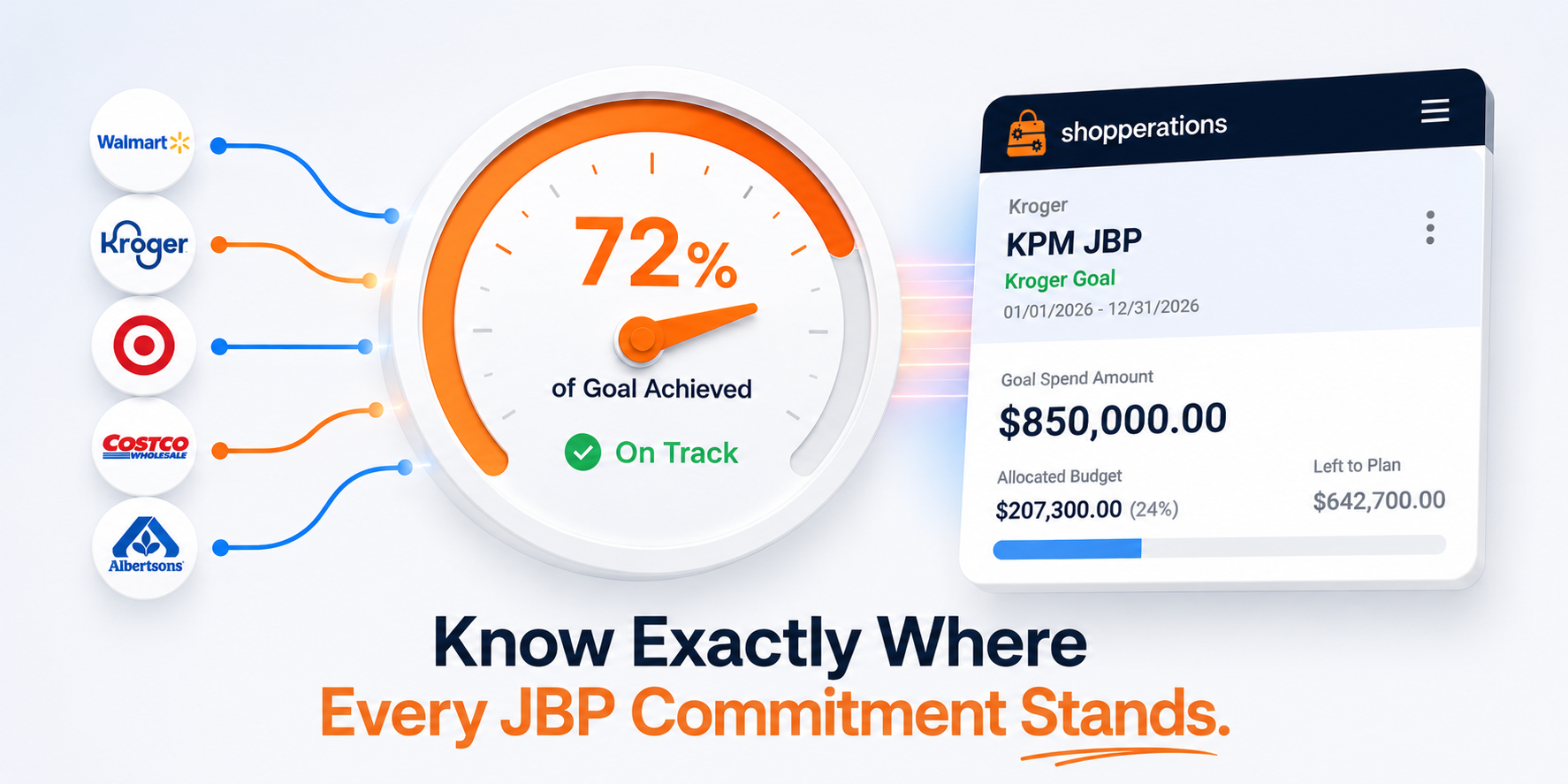
We recently introduced Goals functionality in Shopperations for this purpose. Clients can publish agreed-upon investment goals by retailer and continuously compare qualifying planned activity against those commitments.
The larger lesson does not depend on using Shopperations. Even if your organization still manages JBP commitments in a spreadsheet, define what qualifies, establish one official target, and include the attainment calculation formula as part of the regular planning process, not a separate work stream. A JBP commitment should not require a monthly scavenger hunt to determine whether you are on track.
9. Give cross-functional partners direct visibility into the plan
Shopper and commerce marketing data should not be useful only to the people who created it. Brand managers frequently need to understand customer-level investment. Sales teams need upcoming activity for customer conversations. Finance needs forecasts and accrual information. Analytics teams need to understand what was actually in market before interpreting performance. Yet many organizations still answer these questions through email requests to the marketing team.
We encourage clients to train cross-functional stakeholders on Shopperations even when those stakeholders will never create a plan themselves. A view-only Brand Manager, Finance partner or Sales leader can often answer a question in minutes by applying a filter, looking at a calendar or opening a standard report. The benefit is not simply saving the marketer from answering another email. It creates broader confidence in the information because stakeholders can see the underlying plan themselves.
10. Think beyond shopper: Build a Total Marketing System of Record
Shopper Marketing should not operate as an island. The strongest customer plans are built with an understanding of what the brand is doing nationally, which messages and priorities are being supported, when major campaigns are launching, and how customer-specific activity can extend and amplify those investments.
Yet we often see a strange disconnect in the systems used to manage this work. A company may have made significant progress centralizing shopper and retail media plans while national media, consumer promotions, research, packaging, agency retainers and other marketing investments are still managed in separate Excel spreadsheets. There is no particular reason those investments need to remain separate.
Many Shopperations clients have expanded their use of the platform beyond customer-specific marketing. Different marketing teams can use the same planning environment to manage their own budgets and activities while maintaining appropriate ownership and autonomy over their work.
This creates benefits at both ends of the organization. Shopper marketers gain visibility into national plans and can build better-connected customer programs. Brand and national marketing teams can see how their strategies are being activated with retailers. Marketing and Finance leaders gain a consolidated view of where dollars are going without collecting and stitching together another round of spreadsheets.
In other words, the system of record does not have to stop at the organizational boundary called “Shopper Marketing.” Shopperations can serve as a Total Marketing System of Record, bringing national and customer-specific investments into the same planning environment while allowing each team to manage its own work.
For organizations already using a centralized system for shopper and retail media, expanding that discipline to other marketing investments can be a natural next step toward a more connected marketing organization.
11. Update variable-cost programs frequently enough to change the outcome
Not every marketing expense behaves like a fixed media buy. Coupons are a great example. A program begins with a redemption forecast, but actual consumer behavior ultimately determines the cost. If actual redemption differs significantly from forecast, waiting until the program is completely settled to update the budget defeats much of the purpose of forecasting.
Several Shopperations clients integrate the platform directly with coupon clearinghouses. Fresh redemption information can be received weekly, allowing marketers to compare actual and forecasted liability while programs are still active. If redemption is running below expectations, the team may have an opportunity to reallocate funding. If it is running above expectations, the financial risk becomes visible earlier.
The broader principle applies beyond coupons: when an expense changes dynamically, actualize it frequently enough that the information can still influence a future decision.
12. Automate the operating cadence, not just the movement of data
Automation does not have to stop with financial integrations. One agency partner has used Shopperations data and APIs to build automated communications that help manage the planning process itself. Users and managers can receive reminders when plans need to be completed, event statuses need to be updated, or completed programs still need to be reconciled.
Shopperations already contains alerts and workflow capabilities, but APIs allow organizations to create processes that reflect their own operating rhythms. This is becoming even more interesting as AI makes it easier to build workflows around structured marketing data. Instead of a manager repeatedly asking, “Has everyone updated their Q3 plans?”, the process itself can identify which plans have not been updated and communicate with the appropriate people.
The objective is not to bombard marketers with notifications. It is to automate predictable administrative follow-up so managers can spend their time on situations that genuinely require judgment.
13. Connect multiple sources to create a complete view of marketing investment
A single system of record does not necessarily mean a single enterprise system. Large CPG organizations will continue to have specialized financial, trade, media, retail media, planning and analytics platforms. Trying to force every function into one application is rarely realistic.
One of our large enterprise clients took a different approach. The organization created an internal Power BI environment that brought together multiple types of investment, including National Media, Trade and Customer Marketing/Retail Media funds. Multiple enterprise systems contributed data to that view, with Shopperations providing customer marketing information through its API.
The result was something that would be difficult to achieve from any individual platform: a holistic view of how brand dollars were being deployed across different investment types. This is an important distinction. A planning system can be the authoritative source for a particular type of information while still participating in a broader enterprise data ecosystem.
The more mature question therefore becomes not “Can one system do everything?” but “Can our systems reliably talk to each other?”
14. Connect the original plan to campaign results
Financial reconciliation answers an important question: What did we actually spend? Organizations should also be able to answer: What did we expect to achieve, and what did we actually achieve?
That process should start before the program launches. When an activity is planned, teams should define the KPIs that will be used to evaluate it and, where appropriate, establish expected or target values. Doing this upfront creates agreement about what success looks like before results are available.
Too often, the original marketing plan and the eventual campaign results live in completely different places. The plan might reside in a planning system, execution data in retail media platforms, and results in agency presentations or retailer reports. In some cases, the KPIs themselves are selected after the campaign is over based largely on whatever data happens to be available.
Connecting planning and measurement creates a much more useful institutional history. Shopperations now allows teams to define KPIs as part of the original plan, capture estimated KPI values before execution, and record actual results as they become available. The intent is not to replace specialized measurement platforms or retailer reporting. It is to preserve the connection between the investment decision and its eventual outcome.
Imagine planning next year's Kroger program and being able to find comparable programs from previous years, including their objectives, planned investment, expected KPIs, final spend, execution details and actual KPI results. That provides much richer context for deciding what to repeat, change or investigate than searching SharePoint for a two-year-old campaign recap deck.
Over time, that history becomes particularly valuable for analytics and AI because the organization is no longer accumulating spend data alone. It is building structured knowledge about the relationship between its marketing decisions and their outcomes.
15. Build the operational foundation for AI before worrying about AI
AI is creating enormous possibilities for marketing planning and operations, but it also exposes an old problem: AI is only as useful as the information it can access and understand.
Consider two organizations. One has hundreds of spreadsheets with inconsistent terminology, incomplete activity descriptions, outdated forecasts and no reliable connection between plans and actual spending. The other has several years of structured activity data with consistent customer and brand hierarchies, standardized tactics, persistent IDs, current statuses, forecasts, actuals, JBP commitments, KPIs and campaign results. Which organization is better positioned to use AI?
Once the underlying information is structured and trustworthy, entirely new workflows become possible. A marketer could ask which completed programs remain unreconciled, where the organization is at risk of underspending, which retailers are behind their JBP commitments, how the current investment mix compares with last year, or which historical programs are most similar to a new proposal.
The companies that have spent years improving what might have seemed like mundane marketing operations may discover that they have also been building something much more valuable: a high-quality proprietary data asset.
What about outsourcing?
There is one additional practice worth discussing because it challenges the assumption that a CPG needs a large internal team to achieve operational maturity. Riviana Foods has demonstrated that much of the omnichannel planning and execution process can be successfully managed by a capable agency partner. The important distinction is between outsourcing execution and outsourcing accountability.
Even when an agency performs much of the day-to-day work, the CPG should maintain visibility into budgets, plans, approvals, commitments, results and historical data. A shared system of record creates that accountability while allowing the agency to operate efficiently. For lean marketing organizations, this can be a highly effective model. The technology provides continuity and transparency while the agency provides expertise and execution capacity.
The common thread: Design the operating system, not another spreadsheet
Looking across these practices, one pattern stands out. The best-run omnichannel organizations do not ask marketers to work harder at keeping plans updated, they design processes that make good operating discipline easier. They establish one authoritative plan, forecast early and update it regularly, connect planned investments to financial transactions, automate routine reconciliation, and make commitments measurable. They also give other functions access to information instead of making Marketing answer every question. Eventually, they connect plans, actual spending and performance into a reusable source of organizational knowledge.
Not every CPG needs to implement all 15 practices at once. In fact, trying to jump directly to sophisticated APIs, AI and enterprise analytics without fixing the underlying planning process is likely to create more complexity, not less. Start with the basics: one system of record, common definitions, early planning and reliable financial visibility. Then connect the systems, automate the repetitive work and make the resulting data available to the rest of the organization.
After more than a decade of watching CPG organizations evolve their omnichannel operations, that may be the biggest lesson of all: good marketing operations should make it easier for marketers to spend their time marketing.

OTHER POSTS YOU MIGHT LIKE:
8 Features of a Great Omnichannel Marketing Plan
Overhaul your Budget Tracker in 2026
The Hidden Flaws in CPG Marketing Finance Reporting