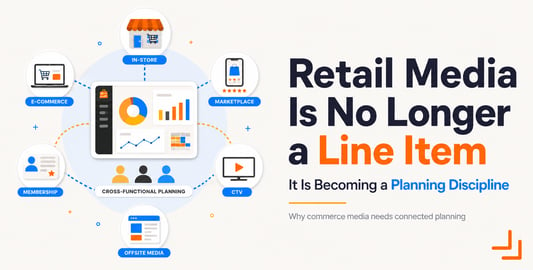
 Retail media used to be easier to categorize. Not easy to manage — let's not get carried away — but easier to put in a box. A brand team could treat it as a media tactic. An e-commerce team could treat it as a traffic driver. A shopper team could fold it into a retailer program. Sales could view it as the price of partnership. Finance could eye it with reasonable suspicion and ask whether it was truly incremental or just another budget bucket with a shinier name. Everyone had a theory. Nobody had a system.
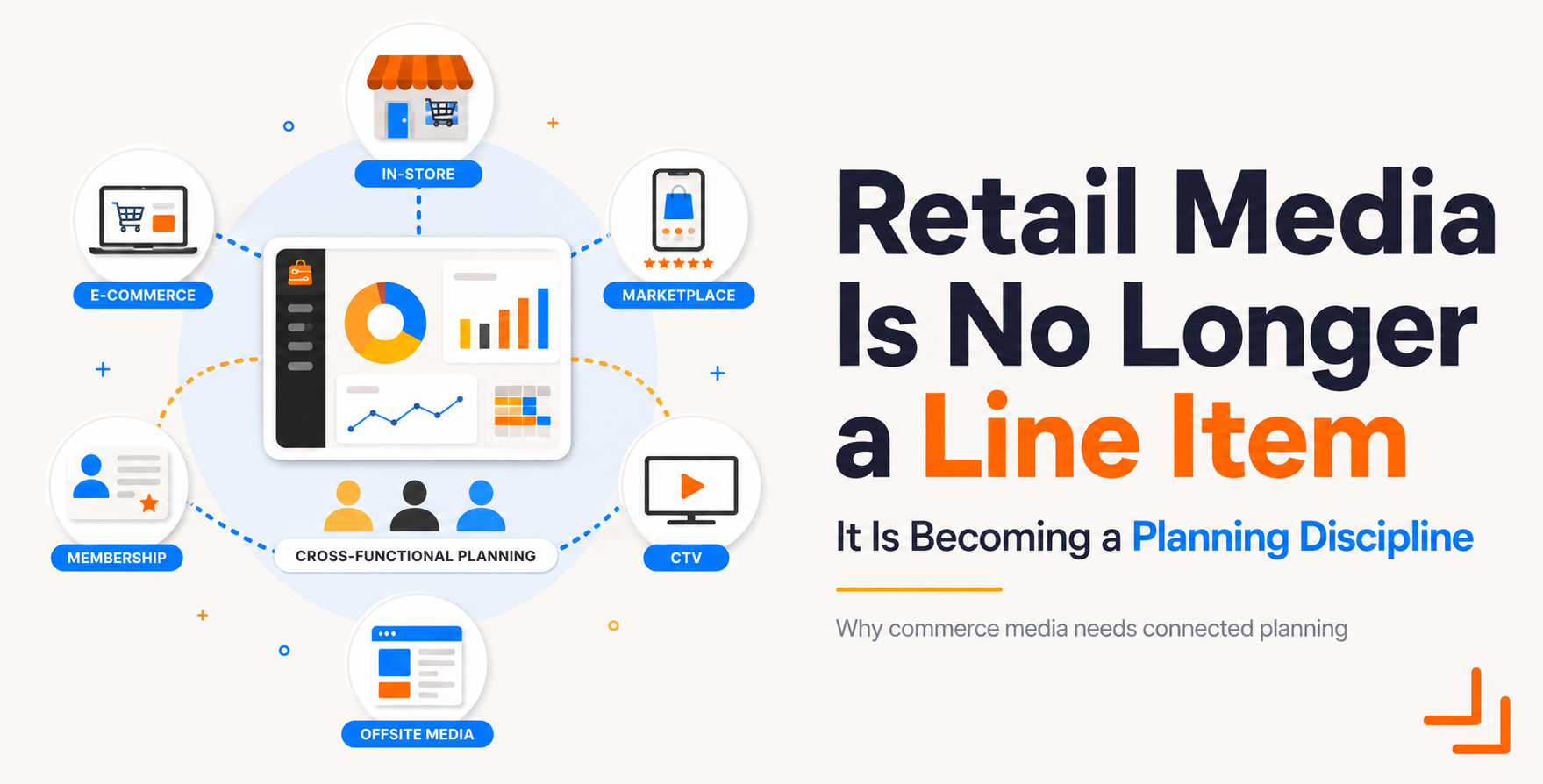
That world is fading quickly, and Walmart's recent global commerce media push is one of the clearest signals yet. Walmart is connecting Walmart Connect U.S., Walmart Connect International, Sam's Club Connect, marketplace, membership, ecommerce, in-store experiences, connected TV, and closed-loop measurement into a single commerce media ecosystem. Its advertising revenue totaled $6.4 billion in 2025, representing a 37% increase globally and 41% increase domestically for Walmart Connect. And just this week, Walmart announced it is acquiring Vibe.co, a self-serve connected TV advertising platform, in a deal reported by the Wall Street Journal at approximately $1.4 billion — building on its earlier VIZIO acquisition to extend its commerce media reach into streaming. This is not a company adding a new ad format. This is a retailer rewriting what it means to be a media partner, and the operational implications for CPG brands are significant.
When retail media was mostly sponsored search and onsite display, teams could still manage it with a combination of retailer portals, agency decks, spreadsheets, and post-campaign reports. Not elegantly, not efficiently, but somehow. Now retail media is expanding into offsite media, in-store screens, connected TV, membership audiences, marketplace integrations, shoppable content, retail-owned DSPs, and AI-powered shopping experiences. Every one of those channels adds stakeholders, adds complexity, adds performance stories to reconcile, and, predictably, adds spreadsheets multiplying like rabbits with admin permissions. The IAB forecasts retail media will generate approximately $74 billion in U.S. ad spend in 2026, with commerce media projected to grow 12.1% this year, faster than social and nearly three times the rate of the overall ad market.
This is the moment CPG teams need to stop treating retail media as a line item and start treating it as a planning discipline.
The problem is not just media complexity
Most retail media conversations focus on activation and measurement, and that makes sense. Brands want to know where to spend, what worked, and how to compare performance across retailers. But underneath all of that is a quieter operational problem that gets far less attention: how the work gets planned in the first place.
Before a campaign ever launches, CPG teams have to work through a long list of practical questions that have nothing to do with bid strategy or ROAS targets. Which retailer is this for? Which brand or portfolio? Which customer team owns the commitment? Which budget is funding it — shopper, brand, ecommerce, sales, or incremental? How does the timing align with the commercial calendar? Is this tied to a new product launch, a seasonal window, a JBP commitment, an in-store event, or a marketplace push? What assumptions were made? Who approved it? What changed after the retailer meeting? What needs to be reforecast? What should finance expect?
These are not glamorous questions. They are also the questions that determine whether a plan survives contact with reality.
Retail media does not live in a vacuum. It sits in the messy middle of CPG planning, where annual plans, customer commitments, funding sources, agencies, shopper programs, ecommerce objectives, and finance reporting all collide. That is why retail media planning cannot be solved inside an ad platform alone. Ad platforms are built to activate and optimize media, they are not designed to serve as the system of record for the entire commercial plan. They do not manage the full planning context: budgets, phasing, approvals, retailer calendars, cross-functional ownership, finance-ready reporting. That missing planning layer is where most CPG teams are quietly absorbing the most pain.
Walmart's move raises the bar
Walmart's commerce media strategy is not simply about selling more advertising inventory. It is about connecting more parts of the shopper journey and giving brand partners more ways to reach, influence, and measure consumers across Walmart's full ecosystem. Under the leadership of Seth Dallaire, Walmart's chief growth officer, the company is building global commerce media platforms that combine scale, full-funnel solutions, and measurement signals across stores, ecommerce, marketplaces, membership, connected TV, and offsite media. That is a powerful offer. It is also an operationally demanding one.
For a CPG brand, a Walmart plan may now involve onsite search, offsite media, connected TV, in-store activations, membership audiences, ecommerce merchandising, marketplace implications, seasonal programming, and closed-loop measurement, with pieces owned by brand, shopper marketing, ecommerce, sales, agencies, and finance, often with limited visibility into what each other is doing. The more connected the retailer's ecosystem becomes, the more connected the brand's internal planning process needs to become. When those two things move at different speeds, the gap is dangerous. It leads to duplicated work, unclear ownership, inconsistent reporting, missed commitments, budget surprises, and the kind of manual reconciliation that consumes entire Fridays. More than that, it makes it nearly impossible to learn from what happened. If the plan, the spend, the timing, the assumptions, and the results all live in different places, an organization cannot build institutional intelligence. It can only build more tabs.
Measurement is not the same as planning
Closed-loop measurement is one of retail media's most compelling promises, and brands are right to demand it. But measurement answers what happened after money was spent. Planning determines whether the money was allocated wisely in the first place. Those two things are related, but they are not the same, and conflating them is one of the more expensive mistakes CPG teams make.
A brand can have a beautiful post-campaign report and still have a broken planning process. It can know a campaign performed well and still be unable to answer whether the right budget funded it, whether the timing was aligned to the broader retailer plan, whether the program was properly phased, or whether the result should change next quarter's forecast. Retail media performance data should not sit at the end of the process as a post-mortem. It should feed the next planning cycle, helping teams compare tactics, retailers, brands, categories, and time periods, and helping finance understand not just what was spent but why it was spent and how it connects to the business plan. That requires structure. Not another disconnected dashboard. Not another spreadsheet. Actual structure, built into how the work gets planned. 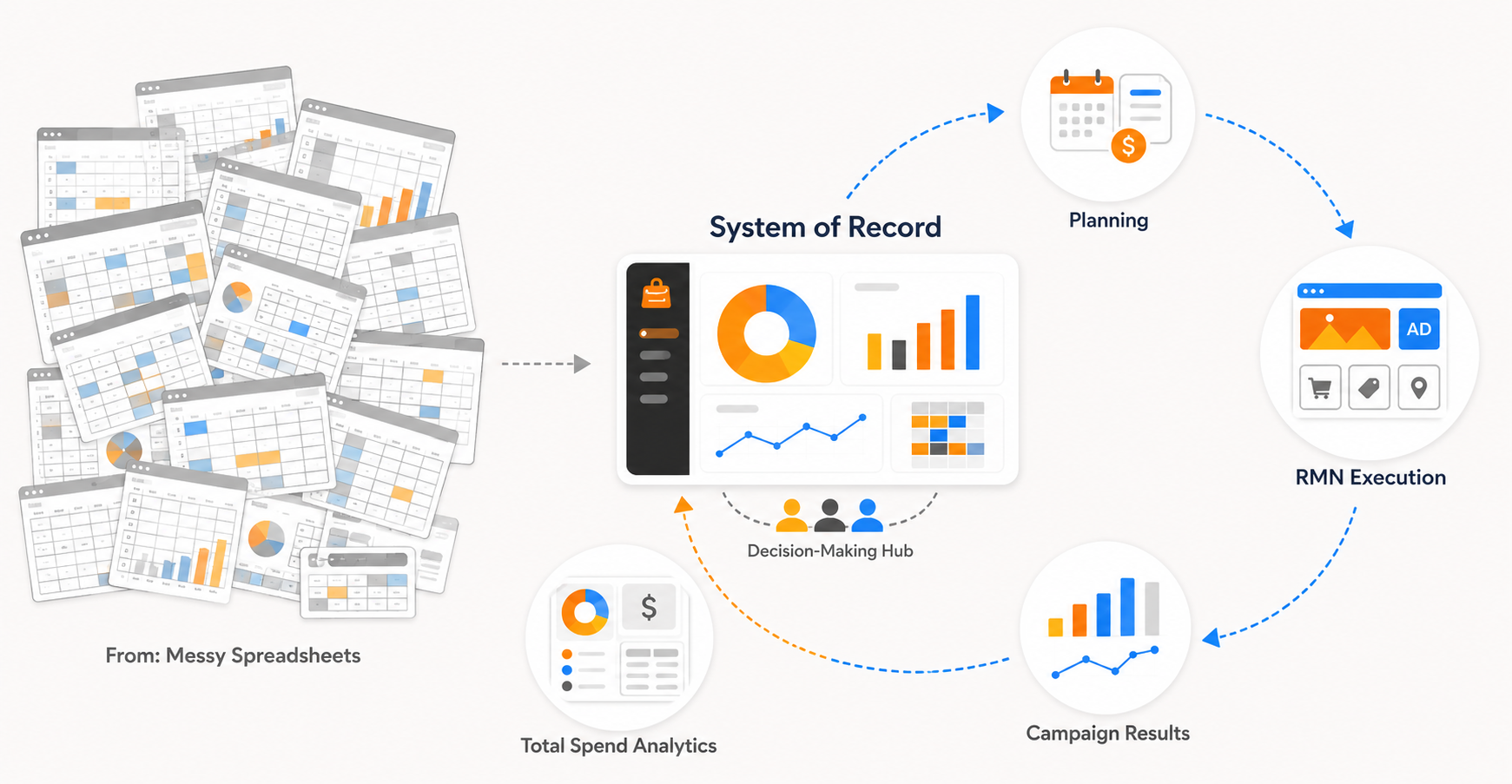
The planning layer becomes strategic
As retail media becomes more deeply integrated into how major retailers grow, CPG teams need a fundamentally better operating model for managing it. They need one place to see planned spend, committed spend, actualized spend, timing, retailer, brand, tactic, owner, status, and reporting outputs. They need a way to connect retail media to the broader shopper and commercial calendar. They need finance-friendly views that do not require archaeology to produce. They need agency collaboration without losing control of the plan. And increasingly, they need clean, structured data so AI tools can actually help, rather than hallucinating their way through a planning conversation like an overconfident intern with a caffeine problem.
This is not a technology problem waiting for the right ad platform feature. It is a planning discipline problem, and the brands that solve it will have a meaningful operational advantage over the ones still duct-taping it together.
The companies that win in retail media will not simply be the ones that buy the most inventory or chase every new format. They will be the ones that build the internal capacity to manage complexity with clarity — that know where the money is going, why it is going there, how it connects to retailer strategy, what changed, and what to do next. That kind of institutional capability does not come from better dashboards. It comes from treating retail media planning as the serious operational discipline it has already become.
Retail media has grown up. The operating model around it has to grow up too.